

Where is your attention?
Replace the Bike Computer; Reduce distraction.

Rider Safety. It’s on everyone’s lips, it’s in everyone’s minds. Every fan, stakeholder and rider is searching for a solution to the puzzle of improving the safety of professional cyclists.
The UCI has suggested limiting gears and is implementing a wider handlebar regulation. On the other side of the coin, several riders who featured in GCN’s latest inquiry on safety are suggesting education programmes (unfortunately, with no concrete specifics as to how this could be implemented).
Michael Woods, during the 2025 Tour de France, closed out his article on safety, with the subtopic suggesting we should Reduce Distraction. Yet, I felt, this portion of his argument was left unnoticed and uncommented on by several media outlets at the time.
Woods said, “If anybody has driven through the heart of a European city during peak traffic hours, with Waze on, a podcast playing at full blast, and an accompanying passenger asking questions, they will know how dangerous distraction can be. Riders effectively do this every day at higher speeds with no seat belts or airbags. Bike computers now provide a range of information, and one only needs to watch a race to see how often we are looking down at this information while hurtling along some European road.”
I agree with Woods that if [the UCI imposed regulations to] remove these distractions, I believe you would place far more emphasis on the [racing] experience and [in doing so] create a much safer environment.
And there is a precedent for this in our not-too-distant cousin—track cycling. Here, racers position their bicycle computers beneath their saddle. They still retain the crucial data for coaches to pore over; the head unit is just removed from the line of sight and therefore reduced distraction from the racing itself.
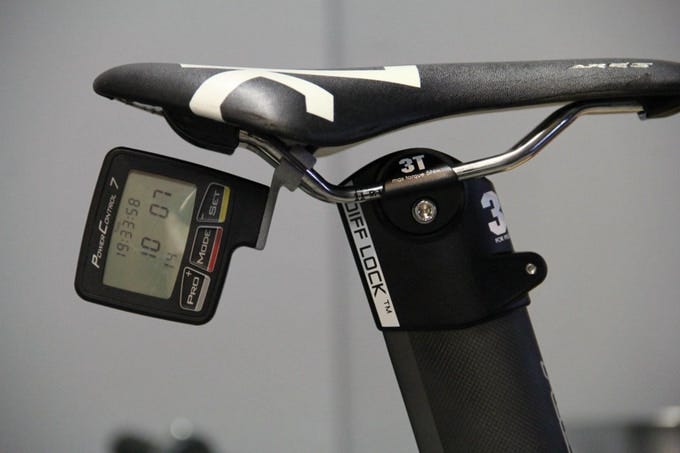
Track racing is one of the purest, most exciting forms of bike racing—no brakes, fixed gears, and elbows out at top speeds. Despite them just doing laps of the same 250m for 50 minutes, they have no information on their Heart Rate, Power or Cadence. They don’t even have speed; just the wheel in front of them, and others’ shoulders bumping into them.
The Elimination race, for example, looks like pure ‘chaos’, yet it is remarkably controlled in the way contact happens, and how aggressive moves are made within the peloton. The sights and sounds of this bring one into the environment—into the moment. The slight creak of the wooden boards bending in the bankings, as the bikes compress into them, as we slingshot around at 60km/h, to the whirr of the taut chain squeaking ever so slightly under the immense tension of the powerful pistons of their legs.
And when one is totally engrossed, one can almost sense something go awry before it does. They don’t have brakes; they don’t have a freewheel. Their only port of call to avoid the crash is to anticipate, be present and swing up the banking and hope the bike doesn’t bounce up into them.
So why do the UCI track regulations deviate from the road cycling regulations in prohibiting the use of the on-bike computer on the rider’s handlebars? In spite of the ever-increasing obstacles tackled in road racing, where head units remain permitted.
I don’t think it would be too much to tempt the UCI to implement this track regulation on the road. At the very least, as a test within a major stage race like the Tour of Guangxi.


Now, I ask you to imagine you’re having a conversation at the table.
I respond to a, hopefully urgent, text message that must be answered, in that very moment (or I’m bored, and just want to escape the conversation for a moment). So I take out my phone below the table, drawing my vision down toward my lap.
In those 30 seconds it takes for me to type my response (and check several other apps as I do), a friend has asked me a question; I didn’t hear them, nor do I remember any of the conversation that led to their question.
I look up in a dazed and bewildered (and slightly ashamed) stare. My face goes red as I ask them, politely, to repeat their question and, as I do, apologise for my distraction.
The phone can take our entire attention to that 6-inch screen, and we become disconnected, ironically, from our environment, as we process its most ‘valuable’ information. The bike computer is no different.
It can be as big as a phone (eh, the new Wahoo), and it is as digitally enticing as it ever has been with its detailed, vivid map screens, and an abundance of data fields to perpetually distract us during the five-hour winter epics—we set up our computers with the aim of reducing boredom experienced on long, sometimes filthy, training rides. I found it intriguing when I first noticed it.
The bike computer sits in an entirely different visual field from that of the immediate racing environment, and thus the peloton around me. So, unlike the phone on my car’s dashboard, our bicycle computers are not in our line of sight, and so we cannot utilise our peripheral vision to effectively warn us of impending dangers, clashes and crashes within the peloton.
Every time we look down (as Woods said, it’s a lot), there is always the potential for a crash to occur in front of us. When that happens, it takes a second or two to refocus on the ‘live action’ and the very dynamic environment of bike racing. And by this time, we will not be able to react. Simply for having been as distracted and paying more attention to the head unit than the road in front of us, as others who have careered into us. Or indeed, hitting the obstacle that brought down the peloton in the first place.
And with that, let me conclude by drawing on an incident which happened on Stage 2 of the Tour de France Femmes in 2022.
In a video of that race, a rider who, I’d hazard a guess, wasn’t paying attention. Especially as they were just off the back of the peloton and pushing hard to rejoin the trailing slipstream of the peloton.
And what do we all do when we push hard? Our vision drops to our head unit in search of ‘moral’ support, providing feedback, to know that we are pushing hard enough. And to assure us that we can sustain our effort. Thus, diverting our attention from the environment of the race, inwardly. We begin to process the information our computers are displaying, which always takes split seconds longer than we think. There seems to be one or two cases of this distraction in each and every crash, which thus creates a seemingly recurring theme and possible reasons as to why the crash was caused.
Be it road furniture, a tight bend in the downhill (tighter than the computer illustrated, at least), or a compression in the peloton that one was not expecting. Not to mention the verbal and auditory impulses we need to create a mental map of our surrounding environment. With this many sensory inputs already having to be processed by the brain, the growing reliance on the bike computer is adding an unnecessary level of risk.
All of which could stem from being distracted by the computer or exacerbated by the computer. If we remove the distraction of the computer, maybe we would be more present, learn to trust ourselves and others, and thereby take rider skills and rider enjoyment to another level. And as a side effect, it could enhance rider and spectator excitement.
So I ask you, might this be a possible evolution in road racing, given it has been the standard in the world of track cycling (where there are fewer environmental distractions) for years?
Everyone is talking about this regulation or that regulation at the moment. What if the solution may be sitting right under our noses, something that has great, perceived importance, and yet stubbornly remains out of sight, and so out of mind?
Replace the Bike Computer; Reduce distraction.
There has been a huge shift in how bike computers (now head-units) are used. Back in 1998 when Chris Boardman started using an SRM he had it under his seat to record the data to then look back and interpret post race - have a watch of Liege Bastonge Liege 1998 to see this in action. Side note: he was good that day! Now though I think most riders couldn't race without one. I've given up eye rolling at the lapping phenomenon in a race - one thing always seemed the antithesis of the other (training / racing) it is how cyclists function in 2025. However, I hadn't considered this as a contributing factor to crashes, because I'm not actually in the bunch to witness or be involved in this kind of sensory overload. I enjoyed the article as it opened my eyes to the fact that this could be contributing to crashes. There isn't really a good reason that you couldn't use headunits for training and not in racing (I mean, riders have radios, and could probably do with paying a bit more attention anyway, there are KM banners all over the shop etc etc). A hard one to go against but worth consideration.
Loving this idea......as a interested and concerned party (a parent) this idea is an encouraging step in the right direction to the reduction of any risk(s) to my offspring (no matter how old they are) is something I find very appealing indeed.